



Predicting Client Churn
AI Churn Prediction: Anticipating Client Departure Before It Happens
ABOUT THE ORGANIZATION
A leading Moroccan consumer credit institution serving civil servant borrowers, managing an active credit portfolio of more than 125,000 clients.
Operating in a highly competitive financial environment, the institution needed to strengthen customer retention strategies and better understand the factors influencing client departure. The challenge was to move from a reactive approach to a proactive one by identifying customers at risk before they leave.
SUMMARY
The institution partnered with Zen Networks’ Data Science team to develop an advanced AI churn prediction solution capable of identifying clients likely to leave their credit portfolio up to two months in advance.
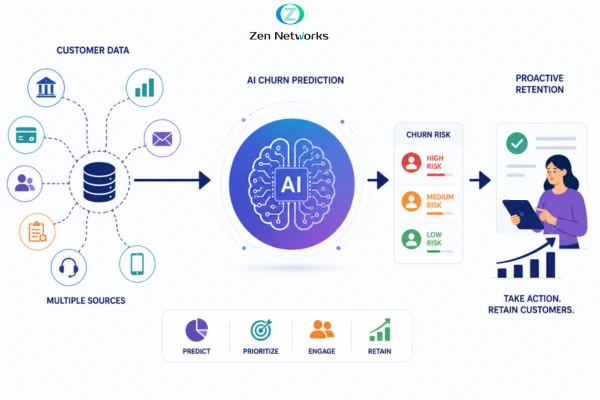
Previously, churn was only visible after contract termination, making it impossible for business teams to intervene effectively. By leveraging artificial intelligence, machine learning, and predictive analytics, Zen Networks built a solution that transforms customer data into actionable retention insights.
The project involved integrating data from 8 different source systems, processing more than 1.4 million records, and engineering 158 predictive variables to capture customer behavior patterns.
The AI churn prediction platform enables the institution to:
- Identify high-risk clients before they leave.
- Prioritize retention actions based on predictive insights.
- Segment customers according to their churn behavior.
- Estimate potential revenue recovery and measure retention ROI.
CHALLENGES
- Detecting Churn Before Customer Departure: The main challenge was the lack of early visibility into customer churn. The institution could only identify customers after they had already exited the portfolio, leaving no opportunity to launch preventive retention actions. A predictive approach was required to detect weak signals indicating a potential departure and provide business teams with enough time to react.
- Fragmented Customer Data: Customer information was distributed across multiple disconnected systems, making it difficult to create a complete customer profile. The absence of a unified data view limited the institution’s ability to analyze customer behavior, identify churn drivers, and build accurate prediction models.
- Data Quality and Missing Information: Several important customer attributes were incomplete, unreliable, or available only in unstructured formats. Transforming raw data into meaningful predictive indicators required advanced data preparation and feature engineering.
- Building a Reliable Predictive Model: The institution needed an AI churn prediction model with enough accuracy to support business decisions. Since retention resources are limited, the solution needed to prioritize precision and identify only the most relevant churn risks.
SOLUTION
- Data Integration and Cleansing: Zen Networks consolidated data from 8 source systems using a unique customer identifier to create a reliable analytical foundation. The process included:
- Data normalization and quality improvement.
- Temporal filtering to ensure accurate predictions.
- Preparation of historical customer behavior data.
- Predictive Feature Engineering: A dedicated feature engineering process was implemented to create 158 predictive variables across different customer behavior categories. These variables captured key churn indicators, including customer activity trends, credit behavior, engagement patterns, and historical signals.
- AI Churn Prediction Model: Zen Networks developed an XGBoost-based machine learning model designed to predict customer churn risk over a two-month horizon. The model was optimized to favor precision, ensuring that retention teams focus their efforts on customers with the highest probability of leaving.
- Customer Segmentation: The solution found four behavioural churn profiles in addition to forecasting churn risk. Each profile was associated with specific retention actions, enabling the institution to move from generic campaigns to personalized customer engagement strategies.
- Automated Operational Pipeline: To ensure continuous usage, Zen Networks implemented an automated monthly scoring pipeline integrated with the CRM environment. The pipeline includes:
- Automated data preparation.
- Monthly churn risk scoring.
- Customer risk alerts.
- Performance monitoring.
- Model retraining triggers.
BENEFITS
- Proactive Customer Retention: The institution can now identify potential churners up to two months before departure, creating an opportunity to engage customers before they leave.
- Improved Retention Efficiency: With a 93% precision rate, retention teams can focus on high-risk customers and optimize the use of their resources.
- Strong Predictive Accuracy: The AI churn prediction model achieved a ROC-AUC score of 0.835, demonstrating strong capability in distinguishing potential churners from loyal clients.
- Measurable Business Impact: The solution identified:
- MAD 47.8 million in addressable churn value.
- MAD 8.9 million in realistically recoverable revenue opportunities.
- Data-Driven Retention Strategies: Customer segmentation provides actionable insights that allow the institution to design personalized retention plans based on customer behavior.
WHY ZEN NETWORKS?
At Zen Networks, we combine expertise in data engineering, artificial intelligence, and machine learning to help organizations transform complex data into measurable business value.
Our approach focuses on:
- Customised AI solutions made to meet the operational needs of each client.
- Business-driven modeling focused on real-world impact.
- Proven expertise delivering scalable data and AI projects.
With Zen Networks, organizations can leverage AI churn prediction to anticipate customer behavior, reduce revenue loss, and build stronger long-term customer relationships.
Author