Sophos Wireless Morocco Secure, simple, and high-performance Wi-Fi 6/6E
In Morocco, Wi-Fi has become critical for productivity: video meetings, payments, SaaS, IoT, and guest access must remain smooth. Sophos Wireless, managed in Sophos Central, provides a clear answer: high-performance Wi-Fi 6/6E access points, built-in security, and unified cloud administration. With Zen Networks, you design, deploy, and operate a reliable wireless network, aligned with local usage and sized for your buildings, user density, and SLAs.

Why choose Sophos for your business in Morocco
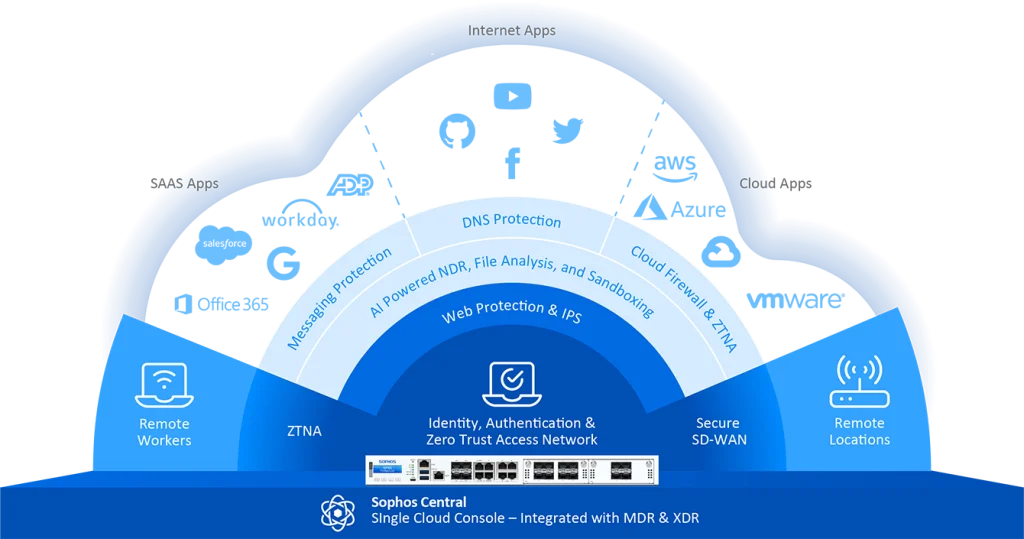
Built-in security and end-to-end visibility
Wi-Fi is a prime entry point for attacks when segmentation and authentication are insufficient. With Sophos Wireless, security isn’t an add-on, it’s native:

WPA2/WPA3-Enterprise with 802.1X to securely authenticate employees.

Captive portals for guests, with session duration, sponsorship, and network isolation.

Detection of malicious/rogue APs and spectrum monitoring to prevent improvised “jammers.”

VLAN/ACL segmentation to isolate production, guests, and IoT (cameras, displays, sensors).
Wi-Fi 6/6E performance for dense environments
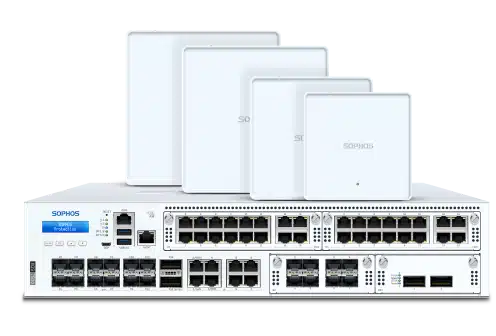
Usage is getting denser: video conferencing, mobile devices, connected POS, IoT, and guests. Sophos AP6 access points, based on Wi-Fi 6/6E, increase capacity, reduce latency, and keep the experience smooth even during heavy load. The result: stable throughput, continuous roaming between areas, and intelligent radio management (band steering, airtime fairness) to avoid peak-hour saturation.
Centralized cloud management in Sophos Central
Sophos Central is the console that unifies management of access points as well as XGS firewalls, switches, endpoints, and email security. You gain consistency, responsiveness, and operational efficiency. Zero-touch provisioning lets you preconfigure a site in Casablanca: at power-on, each AP retrieves its configuration, updates, and policies, ideal for multi-store rollouts or temporary extensions (events, pop-up stores).

The Sophos AP6 range: which model for which use?
Offices, retail, and education (indoor)
For open-plan floors, training rooms, classrooms, or shops, AP6 indoor models combine PoE+, optimized antennas, and band steering. They fit scenarios targeting medium-to-high user density while maintaining even coverage. In a school environment, a typical design is one AP for two classrooms, with careful channel and power settings to limit co-channel interference.

Industry, logistics, and outdoor
For warehouses, logistics parks, or retail parking areas, an outdoor IP67 model withstands dust and weather. It mounts on a mast or wall, is powered via PoE from a hardened switch, and antenna tuning covers loading bays or courtyards. In these scenarios, the goal isn’t just throughput but also reliability and signal stability for scanners and IoT.
Wireless mesh and wired backhaul
When pulling cable is difficult, historic buildings, leased premises, pedestrian zones, wireless mesh links APs to extend coverage. We favor a wired backhaul whenever possible (for capacity) and reserve mesh for extension or redundancy. In a hotel or heritage building, a well-tuned mesh between courtyards delivers smooth Wi-Fi without heavy drilling.
Zen Networks support
Zen Networks brings local expertise (Moroccan environments, operators, RF constraints) and a proven method covering the entire lifecycle, from APX→AP6 migration to managed operations, relying on a complete ecosystem (Wi-Fi, firewall, switching, monitoring) for an end-to-end approach. We commit to results with clear coverage and user-experience objectives and offer financial flexibility (CAPEX or MSP), with bundles and phased rollouts according to your priorities.
Sophos Wireless FAQ
Does Sophos Wireless require a Sophos firewall?
No, APs can integrate into any IP network. However, pairing Wi-Fi with a Sophos XGS firewall provides better application visibility, consistent policies, and centralized logging.
Can we reuse existing cabling?
Generally yes, if the copper cabling and racks are in good condition and the switches’ PoE budget is sufficient. Otherwise, we propose a targeted upgrade plan.
How do we manage guests without risking the IS?
Through a dedicated captive portal, an isolated VLAN, restrictive ACLs, and bandwidth limits. Access logs can be retained according to your policies.
Is mesh enough for an entire building?
Mesh is useful for difficult or temporary areas. For capacity and resilience, a wired backhaul remains the reference. We often combine both.
Which metrics should be monitored daily?
Clients per AP, average RSSI, SNR, retransmission rate, channels, latency, airtime utilization, and average roaming time. These indicators are available in Sophos Central.
How many APs does my site need?
It depends on area, materials, user density, and applications. A site survey remains the reliable method for proper sizing.
Is WPA3 mandatory?
Not mandatory, but recommended. We enable WPA3 when devices support it, with WPA2 fallback for older devices.
What happens if an AP fails?
Coverage is designed with minimal overlap; clients will roam to a neighboring AP. Under managed services, we monitor and replace the AP if needed, according to the SLA.
Contact Us Today!